King Oyo’s Model Farm: Demonstrating the Business of Agriculture
An initiative designed to share practical agricultural knowledge, introduce different farming enterprises and encourage communities to see agriculture as a pathway to economic empowerment.
King Oyo’s Model Farm: Demonstrating the Business of Agriculture
An initiative designed to share practical agricultural knowledge, introduce different farming enterprises and encourage communities to see agriculture as a pathway to economic empowerment.
King Oyo Nyimba Kabamba Iguru Rukidi IV of Tooro established a model farm in Bugaaki Sub-county, Kyenjojo District, with a vision that extended beyond agricultural production. The farm was intended to become a practical learning centre where people could explore different farming enterprises, understand modern agricultural technologies and discover the economic opportunities within agriculture.
For King Oyo, the idea was simple: people needed access to practical knowledge that could help them become more productive and financially independent.
“I established this farm for a purpose because my people must learn how to use different technologies,”
he explained while hosting a group of performing artistes at the farm. Making agriculture a business
One of the central ideas behind the Model Farm was changing how people viewed agriculture. King Oyo wanted communities, particularly young people, to recognise farming as a viable business rather than an activity associated with hardship or limited opportunities.
Drawing from his own experience as a farmer, he encouraged people from different professions to consider investing in agriculture.
He pointed to the COVID-19 lockdown as an example of the opportunities available within the sector. While restrictions disrupted live performances and affected the incomes of musicians, farmers were able to continue their activities and generate income.
“During Covid-19 lockdown, for us farmers we were not affected, we were making money but the musicians were not performing. My advice is that you can make money from music and you invest it in farming,” he said.
His message was particularly directed at young people who were reluctant to engage in agricultural work because of how they perceived it. King Oyo challenged this attitude, explaining that farming could be approached as a commercial enterprise.
“Farming is a business, I am an active farmer and a business man in farming, it’s not a punishment or labour intensive,” he explained.
A practical learning ground for different farming enterprises
The Model Farm was established to expose visitors to a range of agricultural activities and demonstrate how different enterprises could be pursued.
Located in Bugaaki Sub-county, the farm brought together several areas of agriculture, including:
- Livestock and dairy farming: Demonstrating opportunities in animal rearing and milk production.
- Crop production: Including coffee, bananas, mangoes and tomatoes.
- Fish farming: Introducing aquaculture as another agricultural enterprise.
- Goat keeping: Demonstrating opportunities in small livestock production.
- Poultry farming: Providing exposure to another area of commercial animal production.
By bringing these activities together, the farm was intended to give people an opportunity to learn about different agricultural technologies and explore enterprises they could potentially develop themselves.
Rather than limiting agricultural learning to theory, the initiative placed emphasis on practical exposure and knowledge sharing.
Looking beyond production
The vision for the Model Farm also considered what happens after agricultural produce is harvested.
King Oyo planned to establish a storage facility at the farm to accommodate surplus coffee production. The proposed facility reflected the importance of considering storage and post-harvest management as part of agricultural enterprise.
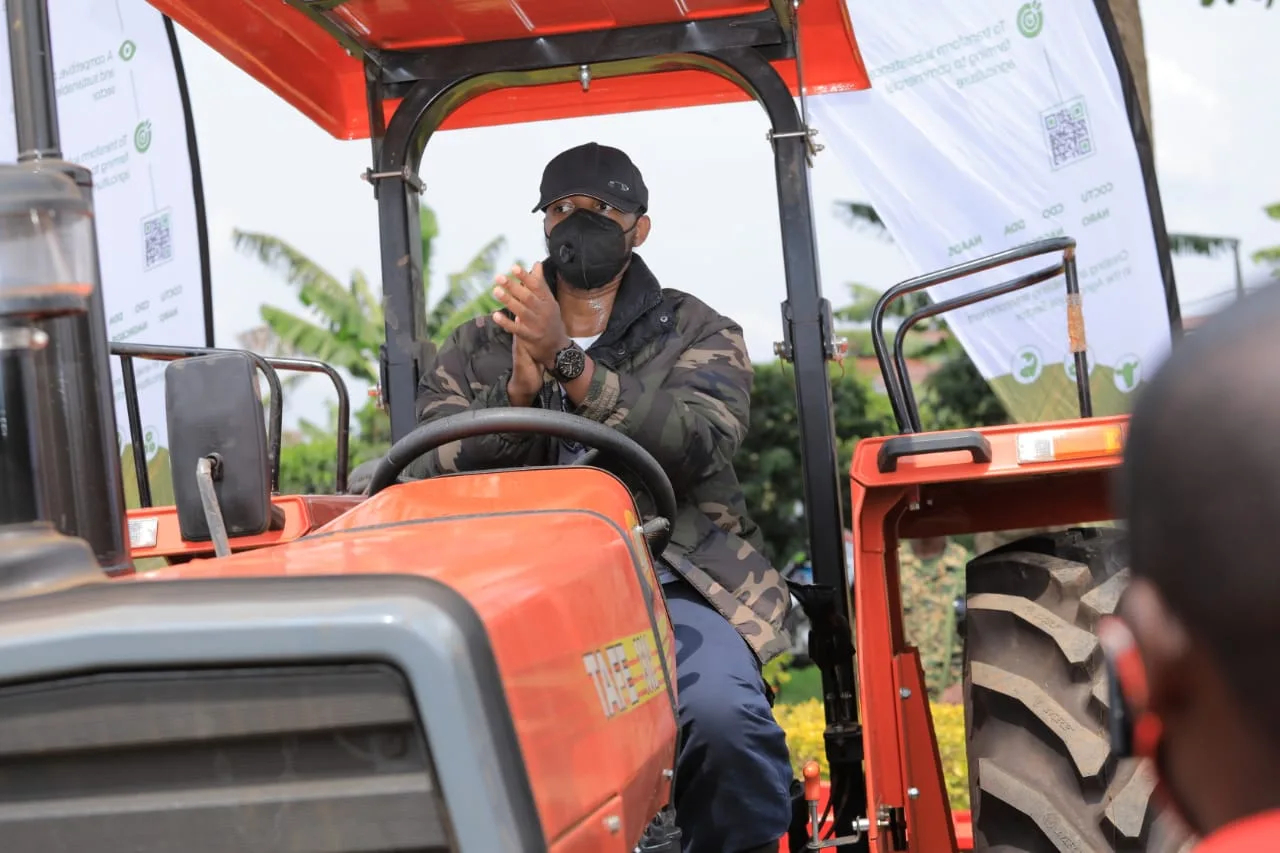
The initiative also attracted support from the Ministry of Agriculture. In January 2022, the Minister of Agriculture, Animal Industry and Fisheries, Frank Tumwebaze, donated two tractors to King Oyo, expressing the expectation that the farm would help uplift smallholder farmers.
This support added to the farm's potential as a demonstration centre for agricultural development and knowledge sharing.
An enduring vision for agricultural opportunity
The King Oyo Model Farm represented an approach to economic empowerment built around practical learning, enterprise and investment. Its purpose was not simply to demonstrate what could be grown or reared on a farm. It was to encourage people to acquire agricultural knowledge, explore different income-generating activities and recognise the commercial possibilities within the sector.
By investing in agriculture and creating a space where people could learn about different farming enterprises, King Oyo sought to encourage a shift in attitudes towards farming, particularly among young people.
The message behind the initiative remains clear: agriculture is not merely a means of survival. With knowledge, technology and an entrepreneurial approach, it can become a business and a source of economic opportunity for individuals and communities.